15 November 2020

Clergymen and their incomes

It’s been a while, because I’ve spent a considerable amount of time in a rabbit hole of online Ordnance Survey maps (thanks to Bing - how appropriate) and a digitised book from 1848* discussing the livings of practically every parish in the UK. So. Much. Data. There will be Graphs. There will be Statistics. on which saints the churches are named after.

From the Jane Austen novels, we remember that people like Mr Darcy and Lady Catherine have patronage over the livings in their gift. This is formally called advowson, the right to nominate someone for a vacant church living, a process known as presentation. The person to be presented had to be ordained by a Bishop, after attending a University and a (cursory) examination. 

However, all clergymen and their livings are not created equal. To understand the difference we need to discuss tithes. The greater tithes were 10% of the cereal crop, wood and hay; lesser tithes were 10% over other crops, livestock and manufacturing profit. Initially this was paid in kind - think one of every ten chicks goes to the church - later a money equivalent was often used or a portion of land (or its profit) was allocated to the church.

If the living was a rectory, the incumbent received all tithes. If the living was a vicarage, the incumbent only received the lesser or vicarial tithes. The greater tithes went to the impropriator, who could be clergy or lay, and often but not always would also be the patron. A parish priest could choose to hire a curate if their income was sufficient (or if they had multiple parishes!).

How much income did a clergyman receive? It varies wildly between parishes, partly but not entirely on whether it's a rectory or vicarage. Rectories, vicarages and curacies were liable to pay the first year of income to the crown, but the poorer ones were often discharged (exempt) of this. As the exemption was based on the value of the living at a certain date, I have grouped them together in the graph.

Of the churches surveyed, 78 are rectories (18 of them discharged), 56 are vicarages (34 discharged) and 25 are perpetual curacies (3 discharged). Another 2 are listed as curacies, 10 are annexed to other churches, and 9 are listed as chapelries of another parish.

The lower end of the income scale doesn't vary much, with 40 pounds for the poorest curate, £42 for the vicarage and £59 for the lowest-income rectory. These people would all be poor, and not be able to have a full-time servant (for which the minimum income was £100-150 depending on sources). But the richest curate gets £258 pounds, which would support a lower genteel lifestyle. The richest vicarage at 1100 pounds is a bit of an outlier as the next one down is £800, but either would support a genteel lifestyle. The highest income for a rectory is nearly 1500 pounds - remember that several of Jane Austen's gentlemen of leisure get 2000 a year. You can certainly see why some clergymen would try and improve their income by marrying heiresses.

One caveat to this data is that it's under 200 churches, all in roughly the same area (I may expand the survey as the data is Right. There....). The other is that this is data from 1830-1848, so a bit later than Jane Austen's lifetime, but I think  they are probably representative values, certainly the right order of magnitude. If anything, they might represent less buying power compared to similar numbers in 1800.  An interesting tidbit to note is that a chapel was built in 1700 for £1000; compare that to Lady Catherine de Bourgh's £800 chimney-piece! 

Who were the patrons of these livings? In other words, who are the useful people to cultivate acquantaince with to get these livings? In at least one-third of the churches surveyed, the lord of the manor is the patron, as Lady Catherine is of Hunsford and Colonel Brandon of Delaford. 20% of the advowsons belong to Bishops, Deans and similar high-up church functions (most of the local cathedral, Worcester), while another 12% belong to other clergymen, not including the 8% of livings where the current patron is also the incumbent. Another 10% of advowsons belong to various Oxford and Cambridge colleges -  includes one belonging to Eton College. The Crown is the patron of 7.5% of these livings and the remaining 8% are other individuals (of which it was not obvious whether they are the lord of the manor, so these numbers may change) and occasional corporations or bodies of Trustees. In 13% of the livings the impropriator is different from the patron, i.e. someone else receives the tithes than nominates the clergyman. Several of the local landowners had 2 or 3 livings in their gift.

So when Jane Austen describes Mr. Collins as having "kept the necessary terms without making any useful acquaintance", she's saying he was very lucky in meeting with Lady Catherine, as otherwise he likely would have been a poor curate at best. Similarly, when Mr. Bennet's advises in a letter to Mr. Collins at the end of the novel, to "stick with the nephew, he has more to give" he may well refer to additional livings.

In "irrelevant asides" today I have statistics on the names of churches. The most popular by far (22 of the 185 churches surveyed) was St Peter, followed by St Mary and St John the Baptist. 20 have a name unique in the group surveyed, while 12 have a name used twice. Of 19 churches I have so far been unable to find the name. We've got three churches each for the local St Eadburgha, who had connections to Pershore; two for St Egwin of Evesham, who had been a Bishop of Worcester; and two for St Milburgha, a nun at Wenlock in Shropshire, as well as a single church dedicated to St Kenelme of Winchcombe.   

Sources and further information:

*A Topographical Dictionary of England, ed. Samuel Lewis (London, 1848), British History Online http://www.british-history.ac.uk/topographical-dict/england [accessed 8 November 2020].

An excellent article about tithes in practice: http://www.jasna.org/persuasions/printed/number16/sutherland.pdf 

https://pemberley.com/?kbe_knowledgebase=servants-based-on-household-income - copied verbatim from Adams' "the Complete Servant", 1825. 

** See also Vicarious: experienced in the imagination through the feelings or actions of another person. "I'm allergic to cats, so I have to enjoy them vicariously through internet pictures".

13 October 2020

Well, you did ask... - Lizzie Bennet Diaries Episode 1-100

My amateur history project appears to have developed into a film review blog for now. Oh well. On my last blog people commented they would like my take on some other adaptations, so here you go. Obviously this is going to contain spoilers, so if you want an unsullied first-time watching experience, click the link to the first video instead of scrolling down. Don't say I didn't warn you!

Lizzie Bennet Diaries (LBD, 2014) is a YouTube series showing a modern take on Pride and Prejudice. I think P&P is probably the hardest Jane Austen novel to modernise, as women can now have incomes and value independent of a husband, and the whole plot therefore makes no sense in modern Anglo-American culture. There is no such thing as church patronage any more, so what will Darcy deny Wickham? In a society where living together before marriage is not a scandal, what does Lydia need rescuing from? With letters hopelessly outdates, how are all those plot points communicated now?

I am aware of two different cultural takes: Bride and Prejudice (2004) and Pride and Prejudice: A Latter-Day Comedy (2003), set in a modern Indian and Mormon background respectively. I'm not sure I could do a culturally sensitive review of those, even if I could get hold of them, as I'm not sufficiently well-versed in those cultures. 

Yes, for those of you wondering: we are going to mention Bridget Jones' Diary. I'll have to admit it's been a while there. I could rewatch it, I suppose... It would be interesting to watch it just as a modern P&P. Don't expect any comparisons here.

Back to LBD. As expected, in a modern Anglo-American setting a mother's complete obsession with her daughters marrying a rich man is somewhat absurd. In the original 1800 setting, Mrs Bennet at least had a point. For educated modern daughters, not so much. It's an interesting choice leaving Mary and Kitty out (for now) but five daughters is quite rare nowadays. 

We have quite an unreliable narrator in media grad school student Lizzie, as it is her video diary we're watching, but with help from fashion designer Jane, college kid Lydia and fellow student Charlotte, she re-enacts the scenes she talks about.

Absolutely loaded medical student Bing Lee has just moved into Netherfield House, with his sister Caroline Lee and friend (William) Darcy, who is heir to a media empire. Their initial meeting (with Darcy's snub) happens at a wedding, which is a good substitute for the Meryton Assembly, and various other meetings happen at a bar, which subs for daytime Meryton as everyone in this has a day job. Less of the daytime visiting and formal parties with chaperones, more bars. Wickham is a swimming coach visiting town. Lizzie and Jane's visit to Netherfield happens because of a house remodel (Lydia visits cousin Mary and Kitty turns out to be an actual cat!). Mr Collins is a primary school friend of Lizzie and Charlotte, who is working in media with venture capitalist Catherine De Bourgh. Instead of proposing marriage, he proposes a business partnership (first to Lizzie, then to Charlotte instead). Lizzie is annoyed when Charlotte takes it and moves away to join Mr Collins at her new job. 

I think they have done a pretty good job on translating the personalities to the modern day characters. There may be some exaggerations, but society is less restricted nowadays, so that seems fair enough.

Good choice to make the extended visits part of the degree work, rather than the house visits of yesteryear. It gives a good excuse to visit Charlotte and then Pemberley. Here I watched a few with less attention, so we're skipping over a few plot points to the DRAMA! I like the choice of letting Georgiana tell her own Wickham history rather than having it from the letter. Speaking of letters, I like replacing the misplaced letters with a new mobile phone. The only thing relationship-wise that could be as scandalous as an elopement is indeed an online sex tape. 

I think I prefer the unrepentent book Lydia in terms of drama, but it's actually nice to see the sisters get along instead. Then there's Darcy buying the website, which makes sense in this story.

It's funny how due to the changes it makes no sense for Lady Catherine to be all against Lizzie marrying Darcy (Anne is a dog in this, remember?). So using Caroline instead is a good choice, and it actually works. 

I like how they gave the whole story a more modern feminist feel by not having the women abandon their careers for the men. But it's still feel-good and fluffy underneath. I feel it's kept to the spirit of the novel remarkably well in a modern setting. Definitely watch the bonus videos too, it's the equivalent of the 1995 wedding...

29 September 2020

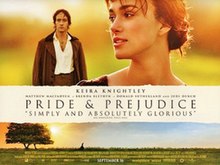
Mostly Prejudice - an attempt at fair trial for the 2005 Pride and Prejudice

Right off the bat, I would like to admit that I am seriously prejudiced in favour of the 1995 edition. And I’m not particularly keen on Keira Knightley. I am going to try to give this a serious chance as a modern (not-1940) feature-length adaptation. 


I like the music at the start here. Is this a classical piece or composed specifically for the movie? Will google later.


I’m not a fan of her traipsing through the washing and things. All the open doors, that looked like a cold morning and you really would have wanted to keep the heat in. How did they get that much washing out before sunrise? 


<fair trial fair trial> 

Why does he have an orchid? Again it is useful for these two scenes to have been rolled into one. 

Why so argumentative. Such noise! 

The house really does look genteel enough. Nice ballroom! That’s a lot of people and a big orchestra! But not as big as it sounds! 

The hairstyles are soooooo far off the mark for any time. The pigtails shouldn’t be seen on anyone above the age of about 12. Ever. And Bingley’s hair. Oh dear*. Queues on the men seem to fit with the earlier-dated costumes, but in general the costuming seems a bit all over the place, from 1780 to 1820. 

The orchestra would NOT stop for the entrance of anyone, not even if he had 5000 a year. I’ve been to dances where people fell over and it didn’t stop like that. Let alone restart like that. 

Again we appear to have left the Hursts out. Why are Lizzy and Charlotte lurking underneath some tiered seating arrangement? 

Ah, this is a line from the visit at Netherfield, this may mean we are spared Mrs Bennet at Netherfield. 

Oi, Liz, how about you don’t stomp down the middle of the set like that? 

Not sure what’s going on with the lighting in the Lizzy-Jane scene. Sunshine, or is something on fire? Oh no it’s night but the curtains are open. 

I’m not doing well at the fair trial thing here. 

Costuming points for the cap on the housekeeper? Also points for having more than one servant. 

Oh no, “shame of such a mother” you wouldn’t have said in earshot. They appear to be using 

That’s a very big breakfast room. Unreasonably big? Why are they having breakfast in a ballroom? 

Oh not the hair down? Honestly, that’s completely unreasonable. And Bingley in a bedroom saying awkward things. That’s fully as inappropriate as a PIG IN THE HOUSE! 

Caroline appears to be wearing actual Regency fashion. But her hair is some sort of modern wedding updo. 

Again, we’re rolling all the Netherfield evenings into one I believe. Without the Hursts one can’t make a card table, I suppose. The dialogue has been made a lot more direct. 

Oh god all the Bennet’s. Looking like shepherdesses and a governess or something. And Mary gets Caroline’s line about conversation at a ball. 

And straight to Mr Collins. Bonus points for background servants, not sure why they look so dishevelled. The conversation here is rather Collins-dominated. I think this Mr Bennet looks a bit too old. 

“Are you familiar with Fordyce’s Sermons?” Is the weirdest pick-up line I’ve ever heard. 

Nice market square, must look up the locations they used. 

Oh look it’s Will Turner. Those girls’ behaviour is atrocious. A-tro-ci-ous. A. Tro. Ci. Ous. *In Gollum voice* It hurts us! *end Gollum voice*


Ah we’re doing the Wickham explanation outdoors, with just the two of them. Improper. 

No, we’re not tight lacing in this era, stop pretending you’re tight-lacing those corsets. Points for having them, points immediately taken away for tight-lacing them and you’re now in negative points for the gratuitous Jane boob shot.


Fair. Trial. 


Apparently we’re all wearing feathers in our hair and Caroline has forgotten to put her dress on. Mind you Lizzie’s dress also looks like she should have been wearing more. 


No touchy! 


I know this music… Is there a slow dance like this in English Country Dancing? Not sure you would keep it with just one fiddle all the way through. 


Cinematically interesting choice to remove everyone else there for a bit. 


Wow, there’s a full foot in height between the two. Again I doubt the whole room would fall silent like that. Also don’t close the piano on her fingers… Don’t sit on the table… it’s like talking to toddlers this. I get the point is to show they’re uncouth, but honestly. 


I don’t think the piano would be in the breakfast room. Also why send everyone to the drawing room, rather than the two people who want to be separate? 


Oh not the stupid weed flower? 


Fair trial fair trial fair trial. 


He does a creditable proposal. I actually rather like the actress who plays Mrs Bennet. Again, nice detail of the servants wrapping up Netherfield and the doors closing. 


Why are we packing? Oh straight off to London. I’m not sure that’s the appropriate carriage. Father’s hair also shouldn’t be loose and why is the swing in a barn? 


Charlotte’s explanation is probably necessary for a modern audience but I dislike it being quite so heated. Time passing on the swing. Not sure the yard should be so muddy. 


Ah again only Lizzy visits Rosings. And the regiment has already left, to the North? 


That is not a phaeton and ponies…. Wow, which house is that? Is that actually Blenheim? Some sitting room. 


Mr Collins looking like he needs the loo! 


Ah we do love us a bit of Judy Dench. And I do like the old-fashioned hair on her. Surprise Darcy! And so many servants. What’s with all the men standing up? I do like they kept the dialogue here. 


Surprise Proposal Darcy? Nope, just Surprise Weirdness Darcy.


Ooh, dull preacher Mr Collins. That’s a nice touch. Not convinced about the chatting in church though. So Inappropriate! And Fitzwilliam isn’t supposed to know about it being Bingley. 


Ooh very surprise Darcy. I do not like the change of the lines here. That book proposal is iconic… and here it goes into a shouting match. For fuck’s sake Lizzy let the man finish a single sentence will you. 


Much introspectiveness and here another man in a ladies’ bedroom. While I agree with abbreviating the letter in principle, I think it can be done better. 


They seem to love answering a ‘how is Jane’ question with a ‘where is Jane’ answer. 


Is that Uncle Gardiner? Oh he seems better when he speaks. But it does always look like they’re hanging around in the kitchen. 


At least we get to go to Pemberley in this one. That’s a majestic tree and excellent deer. Which house is this then? The statue hall could be the V&A… I’m not sure all the naked bum shots are required here. And the portrait is a bust! Novel, but for a moment I was expecting it to turn out to be a full nude, so I suppose we’re still winning. 


Oh nooo, not Georgiana at home? And spying on them? I suppose it’s marginally less anachronistic than jumping in a lake. So there’s that. 


I like Georgiana in this but again the hair down. Darcy after the letter has a lot of Brandon vibes - “give me an occupation or I shall run mad” vibes. 


Oh, early explanations, but not so many. And now Lydia telling all the secrets and how much he paid for the wedding and the regiment. 


Remember this visit is supposed to be awkward. I’m glad they didn’t put in the pointed politeness from Mrs Bennet to Mr Darcy here. And it’s good to have a glimpse of Lizzy liking Darcy here. The lead-up to the proposal is more awkward than it needs to be, and I’m not sure we need to use that sort of language. Oh no don’t all barge in… 


That’s one hell of a tree Lizzy is sitting at. (The house appears to be part English bond and part Flemish bond brick, which means two different parts of the house are from different times, the later after 1775. More on this in a later blog post). 


Ah no please? Lady Catherine after bedtime? They’re all in their jimjams. That’s awful. Why? At least they kept the dialogue their. 


He isn’t dressed either. But they kept the dialogue again. Except for the bewitched bit, that seems unnecessary. YOU’RE NOT MARRIED YET!!!!!!1!!!! STOP KISSING!!!!! Why leave him pacing around the courtyard? Surely there is a room to pace in? 


No weddings :( 


What they did well:

The servants, in general. It’s good they’re visible, and in accordance with the status of people. The actress who plays Mrs Bennet, and the Bennet parents seem to have a better relationship here although he seems rather old. Keira Knightley is growing on me. Mary seems less staid and formal in this, which is quite good. Cutting out Mr Collins’ visit after Lydia’s running away is wise in terms of saving time.


What I didn’t like: 

Inconsistency in costume eras. Points for hats, but removed again for hair styles. Everyone would have at least tried to look fashionable, so having young ladies with good incomes dressed in styles several decades apart is jarring. How poor the Bennet’s are portrayed. All the inappropriatenessessessess: touching, shouting, going out in all weathers, and at all hours, and effectively undressed, sitting on tables, pigs, listening at doors, men in ladies’ bedrooms, impertinent daughters, kissing before marriage. I’m not saying these things didn’t happen, but I expect a P&P adaptation to be almost entirely Corona-proof, except for the hand-touches while dancing. 


All in all, there's still more in here to annoy than to enjoy, for me personally. I'd rather watch an hour of the 1995 than all of this one. I'm sorry to pain anyone, but there it is. 


I may not have succeeded at the fair trial.  


* Apologies, I googled and it appears Bingleys hair is in fact rather on point. It is almost exactly a Titus hairstyle as in this link

22 September 2020

First Impressions: 1940 Pride and Prejudice (P&P0)

It was fun watching the 1980 version, so I figured I’d try the 1940, for ‘feature film length’ to compare with the 2005 one. 


Oh wow, those are not Regency dresses! 

I’d forgotten black and white was a thing, despite having a black and white TV in my student room well into the 2000s. Yes, really, I inherited it with the room. I’m still surprised when Charmed actually turns out to be in colour. I got quite good at guessing colours from grey scale, but an in-depth discussion of whether pink or blue better becomes which daughter... Not convinced. Still, I suppose if you don’t know better. 

Mrs Bennet complaining about someone else’s decorum? Novel... 

A lot of “yes-dear” which I can’t hear straight, only sarcastic... 

Interesting to have the first scene at a shop rather than church. Mary got distracted by a bookshop, that’s a fun detail. A Punch and Judy show? Oddness. Oh Wickham is already here... I suppose that’s a time-saver. 

Carriage race! That’s hilarious!

Liveried servant on the door. Nice. 

Mr. Bennet seems very true to the book and similar to 1995. Interesting this whole conversation is a just the parents. Oh Mr Collins and the entail are introduced here. 

Suggesting some of the daughters should have been drowned at birth seems harsh, though I’m already confused who’s who, so maybe it’s not a terrible idea. 

That’s a sizeable orchestra for a public ball. It’s an interesting dance as well, square but not really a cotillion or a whatsit. And Elizabeth is dancing with Wickham, which   

A waltz? How modern indeed. 

Yes those costumes, we’ll get to them. I like the sparkle on Caroline (I assume)’s gown, good way of distinguishing in black and white. 

Mr Bingley sounds just like Crispin Bonham-Carter in 1995. 

Mrs Bennet cringe, I think the “thank the gentleman, Jane” is probably owing to this. 

Of course we now have the meeting between Darcy and Wickham. 

Gosh my face blindness is really not helped by the lack of colour-coding in dresses. 

The mother and aunt are well-cast, proper mother-hen types. 

I can’t imagine anyone looking good with a bow on top of their head. Too Daisy Duck for me. 

Ah, for time-saving we’re rolling the Assembly and the Lucas party into one, that is a sensible way of doing it. 

Oooh, dancing with someone after you’ve refused someone else, that is Not Done even now. Ah, now we’re also rolling in the Phillips’ evening party. That’s half the book right there! 

More dance fashion geekery, mentioning a Polka/Mazurka. Poor Darcy, that is really abominably rude of Lizzy. 

Now Jane is taking the carriage. Oh no she isn’t. The carriage is being sent back and Miss Jane’s horse brought out. Skip straight to Jane ill. Mr Bingley in the room with her? The doctor appears to be Scottish. Odd. Ah he is Scottish. And ridiculously high-minded in ‘medic speak’ which is all nonsense, but has to be mansplained/translated by Bingley? 

There seem to be no Hursts altogether. 

Why does this remind me of the Sound of Music so badly? 

Mr Bennet discussing sending everyone over to Netherfield. Fun but interesting. 

Ah we’re also running the Netherfield evenings into one. And cutting the visit of Mrs Bennet, which saves a lot of cringing. 

That’s a fireplace and a half... 

Not reading out Mr Collin’s letters certainly saves time! 

Apparently it’s May now for Mr Bingley’s ball, which is a garden party. Caroline really reminds me of the Sound of Music Baroness Schroeder. 

What the flip is with all the calling for Miss Elizabeth. And Mr Darcy covering with Lizzy hiding in bushes? Archery? yes of course Lizzy shoots better so Darcy says he won’t be patronising. 

Mary always good for a bit of comic relief here. I will take this opportunity to add that singing badly well is actually a skill all of its own. 

Have we skipped to Lambton or here or what? I’m deeply confused. We’re apparently spelling out ‘proud’ and ‘prejudiced’ and starting over the relationship. Probably still at Netherfield then. 

“The highland reel”! The tune is Coming Through the Rye. And Mr Collins chasing off Darcy, then reminding her he’s Lady Catherine’s nephew. 

Collins proposal, pretty literal going here. Oh lord just when you think Collins can’t get any worse. He is cringe and may turn out my favourite Collins.  

Wickham has a Rhett Butler moustache. Now we get the rest of Mrs Phillips’ party. While Jane is doing a Marianne Dashwood upstairs. And Sir William Lucas arrives to to announce Charlotte’s engagement, followed by Lady Lucas rejoicing. Skipping straight to Hunsford with a rather bossy Charlotte. 

Oh Lady Catherine is amazingly condescending. Has this word ever been anything but negative? I know Mr Collins seems to think it a good thing, but I’ve always found it terrible. 

Colonel Fitzwilliam in a kilt! This is more than a little whiskey-flavoured. 

Darcy is already trying to listen to what Elizabeth says? Very odd. I wonder how that affects later plot points. 

Honestly Lady Catherine’s face! I’ve seen shorter faces on actual horses... And Anne. 

That kilt is a few inches too short.  

The. Housekeeper. Does. Not. Have. A. Piano. 

Darcy defending Lady C, and being rudely rebutted. 

“It’s no use I’ve struggled in vain” “empty and meaningless days and nights” 

“I love you I love you” “my darling” 

“Knowing Jane how could you hurt her so”

“You dare not speak because you know you’re guilty” 

—-

Ah Lydia has run away with Wickham from Longbourn! No trip to Pemberley then! 

“Yes mama, I know, I know” I use this tone of voice on the cat... 

The Collinses dropped Lizzy off which gets us straight to Mr Collins’ “consolation”. Mr Darcy appeared too? The letter becomes an explanation? No, he’s offering his services. No, it’s both. He’s explaining the near-miss with Georgiana and offering his services, then leaving saying it might be the last time he sees her and finishing like the letter with “God bless you”.    

Now suddenly Lizzy loves Darcy and is being dreadfully unhappy. 

Narrative choice to let Caroline inform Darcy about the continued trouble with Lydia. They’re trying to move out of Longbourn because of the disgrace. How did the disgrace of Lydia result in them needing cheap lodgings in Margate? It makes NO SENSE! 

Blaring horns and a 6-horse chaise to introduce Lydia back, that seems odd as well. Miracle recovery for Mrs Bennet at least. 

How can they be actually rich? Generally W. T. F? An uncle in Jamaica left him a fortune? Is this still Darcy’s doing? “Wicky”? 

Lady C arriving as well! This is getting a full house. While we’re still in an uproar about the move to Margate. All very odd. And Lady C. Ordering Mrs Bennet out of her own room? 

The shoulders on Lady Catherine’s dress are so ridiculously wide I can’t even tell which end of her arm is up... 

She can strip Mr Darcy of his fortune as executor of her sister’s estate? That seems unreasonable. And Lady C telling her about Mr Darcy’s interference with Lydia and Wickham. 

Mr Darcy was In. The. Carriage? And now Lady Catherine tells him to go and propose to her because he needs a woman who will stand up to him? Nonononono. 

Caroline gets to be responsible for Mr Bingley coming back. 

Now Darcy sent Lady Catherine as his ambassador. This is all Topsy-turvy! (Or apparently tipsy-turbo, according to autocorrect)  

And now we’re getting suitors for Mary and Kitty too? 

“Perhaps it’s lucky we didn’t drown any of them at birth”

“Three of them married and two teetering on the brink”

The end

Well that was. Something. Of its time, I suppose. 

What did they do well? Joining up several parties or several evenings into fewer scenes and giving summaries of letters and conversations seems like a good choice for getting a novel down to feature-film length. I quite liked some of the distinctions in costume, the casting was pretty good. Leaving the Hursts and Gardiners out again saves time and (in my face-blind case) confusion with characters. 

What did I not like? Some things did not make sense. Why change the Netherfield ball to a summer party? Why one daughter going missing would suddenly require cheap lodgings in Margate is an absolute mystery. The ridiculous number of people all around at once at the end. Attributing plot points to other people. Leaving out Georgiana and Pemberley entirely, and making Lady Catherine Darcy’s wing-woman? Her disapproval is one of the great joys.  

The challenge with turning specifically Pride and Prejudice into a film is the slow character development. Lizzy is slow to fall in love, Darcy is slow to change under her influence. Contrasted with many boy-meets-girl-meets-obstacle-gets-removed-happiness kind of stories where the obstacles are more external, that is. Foreshadowing slightly, in 2005 as I remember it the change in Darcy happened too slowly. Here, he started to change too soon, which means that by the proposal she should not hate him as much. They apparently changed that by bringing the news of nefarious treatment of Wickham back in the story, but I wonder if it would not have been served better by bringing the first proposal forward, so more of the film can focus on the change. 

Costumes, of course (yes, you’ve been waiting) are Not Regency. I am no expert on this Gone-with-the-Wind-like era, but as far as I could tell it was reasonably consistent and the dances mentioned were in keeping with the dress? The only part of the costume I feel qualified to comment on is the kilt; it’s too short. Kilts should reach to the bottom of the kneecap. Colonel Fitzwilliam is not old enough to have a fat belly that raises the hemline. So I suppose largely points for consistency on this one. It’s a choice.  

Come back next week to see me attempting a fair trial for the 2005 one. I think I was right, and it will be easier after watching this version tonight. 


19 September 2020

What is genteel?

 “He is a gentleman; I am a gentleman’s daughter. So far, we are equal.”

“True. You are a gentleman’s daughter. But who was your mother? Who are your uncles and aunts?”

A lot has been written on the topic of gentility in the context of Jane Austen’s novels. I will not rehash all of it here, but attempt a summary to ensure future posts where I discuss particular characters make sense. Feel free to skip this post if you are a Republic of Pemberley stalwart, or correct me where I’m wrong. The examples I give here will be from the novels. If you want to read about real examples, I recommend ‘A Gentleman’s Daughter’.  

The English society in the Regency looked like a pyramid:

Figure 1: a clumsily drawn (by me) pyramid diagram of society as explained in the text below. 

Royalty 

The royal family, basically one extended family which also encompasses some of the nobility. 

Nobility

300 or so titled families, i.e. Duke/Duchess, Marquess/Marchioness, Earl/Countess**, Viscount(ess) and Baron(ess). 

Landed Gentry

“Approximately (in 1803) 540 baronets, 350 knights, 6000 landed squires and 20,000 gentlemen” totalling 1.4% of the population, ~27000 families (numbers of nobility and gentry from: Thomas Keymer, Rank, in Jane Austen in Context, ed. Jane Todd, Cambridge University Press, 2005). 

Clearly, there are distinctions within this class as Lady Catherine points out. She and her sister are daughters of an earl Fitzwilliam, and their brother is Col. Fitzwilliam’s father. Note that both the “respectable, honourable, and ancient -- though untitled -- families” the earl’s daughters married into have names of French origin: Darcy (D’Arcy) and De Bourgh. Presumably this means the families have come over not long after the Norman conquest (1066 and all that) which would make them properly ancient by 1800. 

The estate (a word now more associated with last will and testament situations) will usually have included a house, park, farmland often worked through a ‘home farm’, possibly a village (which is why Mr Bennet can threaten to not allow officers in the village, although he probably wouldn’t be able to enforce it), hunting and shooting rights and possibly the advowson. In return the head of the family would be expected to look after tenants and the poor, possibly settling disputes as justice of the peace. The incomes associated with estates are rental income (from farmland etc.). 

People who have made enough money can purchase an estate and become ‘landed’, which is what Sir William Lucas and Mr Weston have done and Mr Bingley aspires to. These would become available as current owners have no heirs or fall into financial difficulty. However, in the same way that everyone knows anyone’s income, their ancestry would be known, so purchasing an estate was no magic bullet to respectability. 

Genteel professions 

These are the professions deemed suitable for the younger sons of the gentry, i.e. those not inheriting an estate. The distinction is that for genteel professions, technically one wasn’t paid, but got a stipend, dividend or some sort of living in kind. Marrying rich was definitely prudent as the income did not support the lifestyle to which one had become accustomed. 

Army and Navy officers: one needed to buy and sell these jobs, which meant a lump sum was required to start, and more lump sums to rise in the ranks. From what I’ve read (see further reading below) it was somewhat easier to get by on merit alone in the Navy, especially if your career happened around a war, than in the Army. But note that a Navy Lieutenant is considered an unsuitable match for Miss Frances Ward (£7000) or Miss Anne Elliot, whereas a Captain with a fortune is fine.  

The Church required a University degree and to ‘get ordained’ or ‘take (holy) orders’. One could then be presented as the next incumbent of a living when it falls vacant, a process called ‘advowson’. The advowson of a living was part of some (but not all) manors. This is why Mr Collins is so lucky to have met Lady Catherine just when the living of Hunsford fell vacant - if she hadn’t presented someone within a certain time, the church would have nominated someone instead. The presentation was also what was promised to Wickham by Darcy the Elder, but what makes it valuable is the income associated. This will be a separate post at some point. 

Here it all becomes a bit fuzzy. The law ranged from barristers in London, who could be very influential, to the country attorney Mr Phillips (who started as a clerk in Mrs Bennet’s father’s practice), Similarly, the wholesale dealing of cloth and other goods was considered genteel enough, even if you lived ‘within sight of [one’s] own warehouses’, but retail selling of anything was not. 

Common trades

The apothecary, shopkeepers, tradespeople such as dressmakers, tailors, cobblers and shoemakers, richer farmers like Robert Martin in Emma. These trades would employ have a variety of apprentices, shop boys, maids-of-all-work and the like. 

Working class

Think labourers, assistants, servants and the poor. Possibly the only class that generally would be servants/employees rather than employ them. 

—-

The lines between these classes can be rather blurry, and the class thing was* as much a state of mind as a matter of income. People could work their way up from middle class through genteel professions to buy an estate and become gentry (Sir William Lucas, Mr Bingley, Mr Weston), or inherit an entailed estate (Mr Collins). Marriage to an heiress could make your fortune (Willoughby, Mr Elton, Lady Bertram, Mrs Bennet). 

On the flip side of the coin, fortunes could be lost. Younger sons of the nobility and landed gentry would take genteel professions (Col. Fitzwilliam, Col. Brandon, Edmund Bertram) The death of a husband could mean financial ruin for the widow and daughters (Mrs Dashwood, Mrs Bennet’s fears, Mrs and Miss Bates). Poor financial management could cause a serious reduction in circumstances (Sir Walter Elliott, Tom Bertram to some extent). And poor marriage choices could take you from reasonably affluent to dire straights (Lydia Wickham, Frances Price nee Ward). 

There were no real safety nets, although being considered genteel to start would give some respectability even if circumstances deteriorated. For example, the late clergyman’s wife and daughter Mrs and Miss Bates in Emma, are still considered fit company for Emma and her father and Mr Knightley. And Mrs Dashwood, Elinor, Marianne and Margaret are still suitable companions to Lady Middleton.  


* The class thing still is a state of mind to some extent in modern-day Britain. 

* Huh, funny. Count is a word in English but seems to apply only to mainland European nobility, cf Count of Monte Cristo, Count Dracula. Clear French root. I wonder if Earl is from the Anglo-Saxon, like cow. One googly aside later: yes, earl came from ‘eorl’ or chieftain (Scandinavian ‘jarl’ and was in feudal English more like a duke. The female form never developed so 


Further reading: 

A gentleman’s Daughter

Thomas Keymer, Rank, in Jane Austen in Context, ed. Jane Todd, Cambridge University Press, 2005)


First impressions of the 1980 P&P part 2

Episode 4: 

”I never speak of it as I said to my sister Phillips the other day” LOL

Hey, this is odd, dad asking Lizzy’s opinion

Lydia foreshadowing, hmmmm... 

Rude, Mrs Bennet. 

Oh more internal monologuery... 

I really do need to look at the filming locations for this. 

That almost looks like the same Mrs Reynolds at first glance. Although she sounds almost Scottish, or Northern at least. Even further North than Derbyshire. 

Oh god more internal monologousness. I know these are lifted pretty much straight from the book, but I’m not convinced by them as a cinematic device. 

Hello dog? Hello Mr Darcy! 

Monobloodylogue. Where is he? He’s behind you! He’s on the bridge! Following you! 

No! Without Jane she is Miss Bennet, not Miss Eliza, that’s so improper! 

Miss Darcy, the last of the major characters to be introduced! But we don’t get to see much of her. 

Why is Lizzy wearing her outdoor clothes at Pemberley? That makes no sense at all. 

I’ll need to go find the book to see if this was in it. Otherwise I call plagiarism on P&P2. (Checked, it was. P&P2 is absolved). 

Here the letter is changed and I quite like the fact we’re seeing Mr Bennet here, although not convinced about the lines. 

She ran all the way to Pemberley? FIVE MILES? 

No, not placemats. Dreadful, get a proper tablecloth like, yesterday. 

I’m not convinced by the stairs. 

Episode 5: 

Of course you couldn’t get a letter from Mr Darcy....  You are not engaged, it would be improper to correspond. 

Mrs Hill sounds very Northern for Hertfordshire. I mean I know it’s outside the M25 but it’s not exactly Yorkshire is it... 

Interesting to see the argument about Lydia and Wickham visiting Longbourn. Why is Mrs Bennet involved in making beds? Silly woman indeed. 

Oh Mary gets Lizzy’s line about events looked forward to. 

I like Wickham’s tassled Hessian boots. 

Mrs Bennet is not as pointedly horrible to Mr Darcy when they visit again. 

Wait, we appear to have strayed into Persuasion here with this unnamed other woman. Not convinced by Jane’s extremely twirly ribbons in her hair. 

Less of the awkward Lady Catherine conversation, that’s good. 

A character ‘celebrated for it’s frankness’ = someone  so incredibly blunt and arseybut too powerful to ignore. Ca plus ca change...

I want Lady Catherine’s velvet spencer. Excellent upper class accent, saying ‘gel’ for ‘girl’. No “shades of Pemberley being thus polluted” though. 

Wow, mother, not so close. You’re in my *face*. 

A letter? How odd. Ah, it’s a note to come outside. And we’re skipping the wedding, that’s a shame. 

In conclusion: 

As I said somewhere in this, the overall feeling is like listening to a different version of a favourite song. It is very very similar to my beloved 1995/P&P2. There’s some subtle differences, but the wording is very similar. And they’re a fairly similar length, so I think a direct comparison is not unfair. 

What they did well: costuming, I believe is well done in this version. Mrs Bennet seems a bit younger, and gets a few more lines. I liked some of the cinematography. Characters were introduced well at the start. I agree that Mr Collins in this seems better cast than in 1995. 

What I didn’t like: Oh the monologues! Either the monologues with someone else in the room, where the other person may as well be a rubber duck, or the close-up view of a face with voiceover. I appreciate the narrator is important in the book, but this I think is definitely a case of show-not-tell. I missed the wedding scene, replaying that in my head got me through an incredibly dull wedding recently. I wasn’t entirely sure about some of the dancing, but I’m not a dance historian, merely a Scottish Country dancer. The music grated after a while (time spent in menus did not help, I muted it while making dinner in the end). Some clumsy scene transitions perhaps. 

I can see how Andrew Davies’ version definitely owes a lot to this one, as well as the book. They clearly chose to add a bit more carriage rattling and other drama in the 1995 version.    

The 1995 version with Colin Firth and Jennifer Ehle will always be “my” version, as it was what first brought me to Jane Austen, probably not very long after it came out. I watched it with my mother on terrestrial television, that long ago. I then went to the library to get the books, possibly in translation before braving the English section of our library and subsequently devouring that. That brought me to Terry Pratchett, so I owe a lot to P&P2! 

I will try and gather courage to rent the 1940 and 2005 versions to stream. As they are both a shorter ‘feature film’ length, they might fare better in a like to like comparison than comparing to a 5 or 6 hour miniseries, which gives much more time for character development. I’ve seen the 2005 version before and I have Opinions on it... but watching 1940 first may give me a better appreciation for the limitations of length. 


18 September 2020

First Impressions of the 1980 Pride and Prejudice (part 1)

Yes, that is a deliberate title. I was singing the praises of the 1995 Pride and Prejudice (or P&P2 in the Old Republic of Pemberley parlance) on Facebook and some of you recommended this one. I thought it was on Prime, but apparently not on the UK. But as I had my heart set on it for Friday night, DVDs were purchased. Here we go!


Episode 1:

First thoughts, the lines seem pretty close to the book. 

Actual day dresses with higher necklines and/or fichus! 

Women working at night, good thing. 

Kitty looks like the 1995 Lydia. Jane looks like Maria from P&P2. Generally they look very similar, that’s going to give me trouble, I’m not great with faces. 

I don’t think I like this Mr Bennet any better than P&P2. He seems even more teasing. Mrs Bennet seems a little more appropriate aged. 

A lot of monologuing to ones sisters. 

Why is there a tapestry on the table? Why are the lines alternating ladies and gentlemen for that matter. 

Darcy has some jaw on him! 

Actual gloves in the evening! Interesting building for the ball. 

I like the picture of Mr Bennet snuffing all the candles while his wife is nattering on about the ball. 

Long stays, pretty period-appropriate. 

Interesting cinematographic idea to go “I wonder what they’re saying of us” and cut to the others. Also interesting to have one party undressing and the others still playing cards. 

Not sure about the heavy (eye) make-up, but I suppose it was the 80s. 

Is this slow paced? It feels slow-paced... Maybe it’s the overacting. 

That’s a very polite picture of people listening to the music. Quite conspicuous of Darcy to move. VERY impolite to start other instruments while Mary is playing. Oh but Mrs Bennet gets the Netherfield line. Sir William seems a bit older... 

Ah, the ‘fine eyes’ speech, soon followed by the ‘only way’ speech and the ‘silliest girls’ speech. 

If it wasn’t all so true to the book I’d be starting to think Andrew Davies plagiarised the lot for P&P2... 

Nooooo, not walking in the actual rain! That’s ridiculous! That’s completely out of character for Elizabeth. The whole point is that Jane couldn’t get back because of the rain. That kind of behaviour is much more Marianne Dashwood. Not convinced by this AT ALL. 

Is that the same music as in P&P2? I’m sure it is... 

Ok, Darcy is growing on me. I like his voice. 

Very 1700s furnishings, quite appropriate for a house that’s rented out. 

Oh dear god the mother is visiting. She kept her hat on at least, maybe she’s not staying long. 

FOUR AND TWENTY FAMILIES

Cringing at the mother quite as badly as Bingley’s sisters... 

I’m enjoying the riling of Darcy by Bingley. Hey a reel, I’m sure I’ve danced to this. 

Oh the “take a turn”, followed by the usual things. 

Ah good, we’re leaving. Bloody hell Caroline, that’s mean. 

I like the cut to Darcy and Bingley looking wistful or bored. 

Episode 2:

Can Mrs Bennet stop GOING ON about Charlotte Lucas? 

Mr COLLINS! Very tall isn’t he! Again, comedy background music for Mr Collins. I’m not convinced I like him scouting out the property. He is a bit obvious about the plans to marry one of the daughters in this. As is Mrs. Bennet in suggesting Elizabeth. Like the details for the carriage in Meryton. Random soldiers not so much. 

Bloody hell Denny, stop praising Wickham. Not sure adding dialogue here is quite necessary. Introductions from horseback? Oh dear Mrs Phillips is very vulgar. 

Does Mary’s hair deliberately look like Maria Von Trapp? 

Netherfield!!! Such an angry Lizzy. Fans!! Inappropriately close as well as clumsy dancing from Mr Collins. What a strange dance this is that Lizzy and Darcy are dancing. 

I’m currently wondering where they are going to gain the time that this one is shorter. 

*cringe* Mrs Bennet is back. 

*double cringe* Proposal. I’ve never seen ‘gritted teeth’ acted so well as by Mrs Bennet here though. 

Collins’ hair is awful. I like Lizzy’s “well I thought you were never speaking to me again, I can’t wait” look. 

The whole experience is rather like listening to a cover of a favourite song (or indeed, the original if you’re used to a cover), it’s all nearly the same but not quite. 

Such a comedy sneaking for Mr Collins. Oh there’s an actual tote-a-tete scene between them. Yikes. 

Don’t mention the war! Oh Mr Wickham is engaged? Novel! Miss King has not inherited 10000 a year. Oh no Sir WIlliam in the visit? Or Maria, but nobody ever remembers Maria... 

ROSINGS! ROSINGS seems mostly big. Oh Mr Darcy is there already. I like the servants. No Fitzwilliam? I’m not sure Dr whatsits rules for health are any recommendation if Anne is following them. I’m tempted to make a stain on velvet to see if it can be removed with butter. My instinct is it won’t. Ah here he is. 

The housekeeper’s room would not have had a pianoforte... How is Lizzy’s taste affected by her sister’s being out? What’s the nonsense with the hat? 

Such an angry Lizzy!

`proposal!

I may even prefer the intonation in this one. Not keen on the monologue in the head afterwards. 

Quire a lot of changes in the letter here.  

Not keen on this monologue either - I prefer the flashback. 

The iPAD/blogger combo seems to be a bit troublesome, so I’ll break off here and start a new post for the second DVD. 

23 August 2020

Buckle up for a history of shoes!

Thank you to the people who reacted with enthusiasm to my mad idea! It makes me much more excited about sharing it. 

Since my last post, I more or less threw all of my plans out of the window and ended up thinking about walking in Regency clothes. And specifically, shoes. For a walk nowadays I wear hiking boots or low trainers. Made of Gore-Tex and rubber, they are waterproof, have a sole with grip, are nicely padded and have ankle support. While I could hide them under the dress, they wouldn't be in keeping with the project. For the proper experience I think the footwear is particularly important. We can imagine the sort of issues a walk in a long dress would cause - snagging, tripping, stiles etc. The shoes add other challenges, like slipping and twisting ankles. Bear in mind that if your shoe gets punctured by something, an infection could kill you!

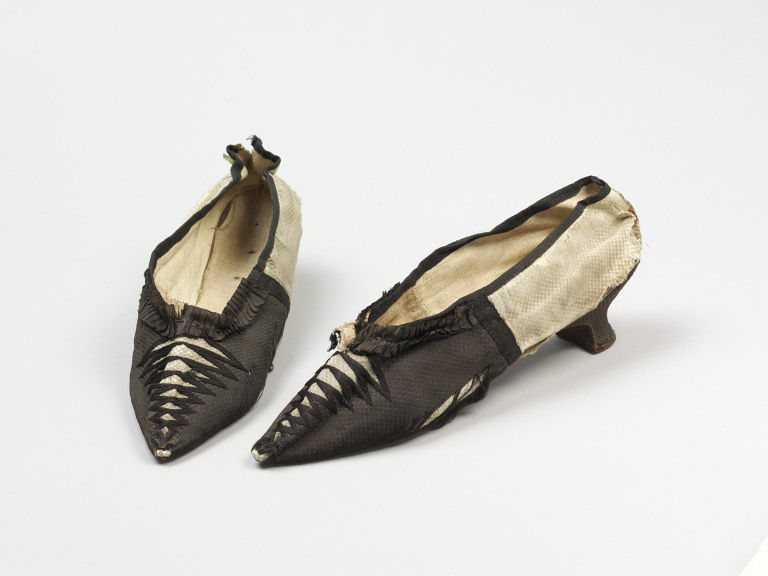
Shoes, 1790s, black and (very faded) blue.

Shoes would have been made of leather, possibly with cloth uppers. Experiments with country dancing demonstrations on paving show that the soft leather soles of my ballet shoes did not last long. Similar experiments on grass indicate that leather dancing shoes also don't do well on wet surfaces - they're slippery and not waterproof. At least country dancing does wonders for the strength of your ankles. While the paving may have been less of an issue (no tarmac or concrete roads), Lizzy definitely encountered plenty of mud.

Buckle up for a history of shoes from the V&A archives! (all images from V&A unless otherwise indicated). Caveats here are that I'm not a historian of any fashion, I have only researched museum collections online, and that utilitarian shoes are less likely to survive than pretty ones. 

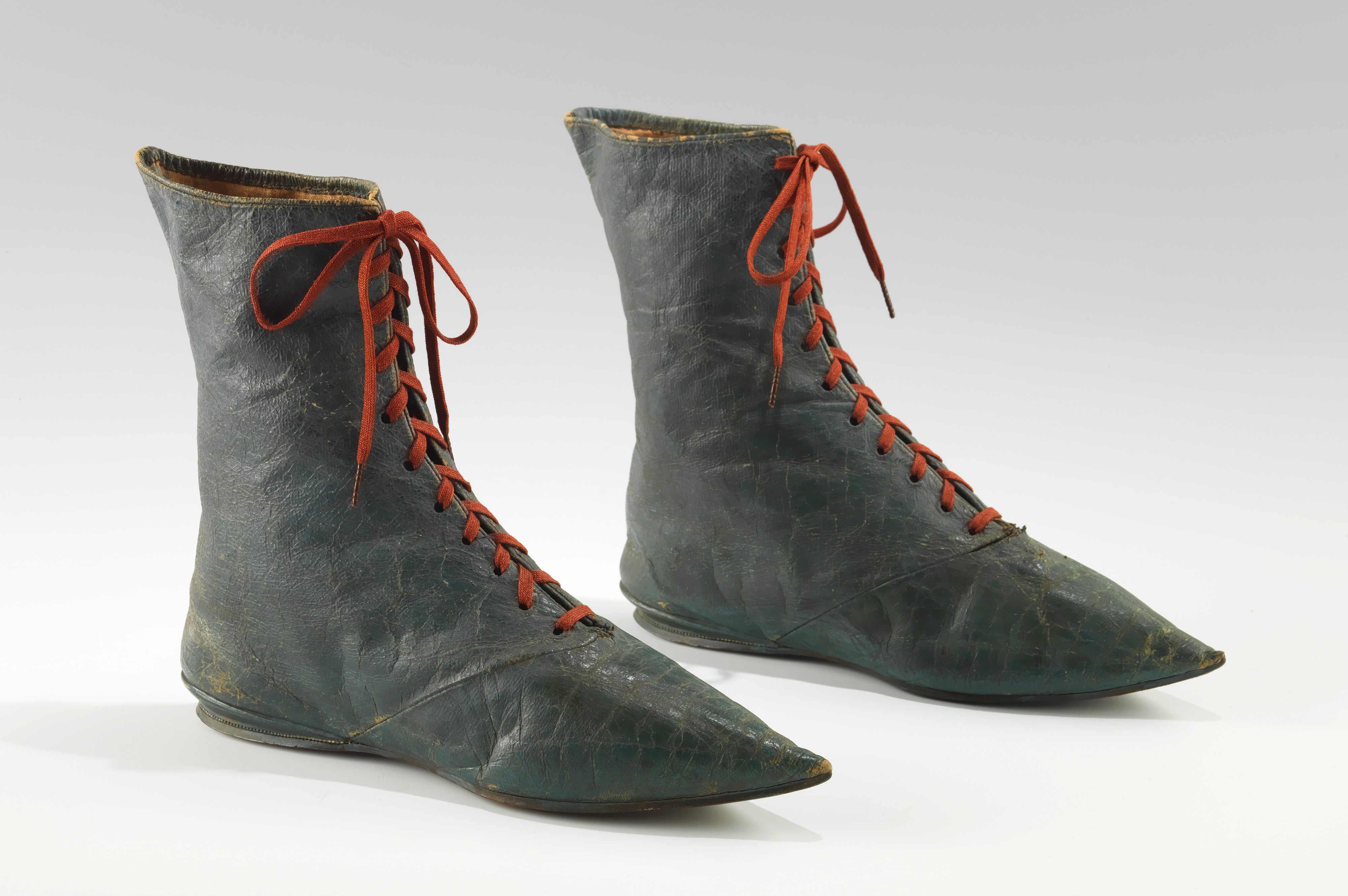
In the 1797, when Jane Austen was writing the first version of Pride and Prejudice, we have pointy toes and small heels (as opposed to big heels earlier in the century). Boots for ladies had been used for riding for a while, but now started to be used for other purposes. The American Duchess historical shoe blog seems to date their leather half-boots as accurate from 1790, and has leather Hessian-style boots for the same date. Maybe Elizabeth would have worn boots, like the ones from the Met below. 

Leather boots from 1795-1815, with pointy toes and a small heel. The Met museum


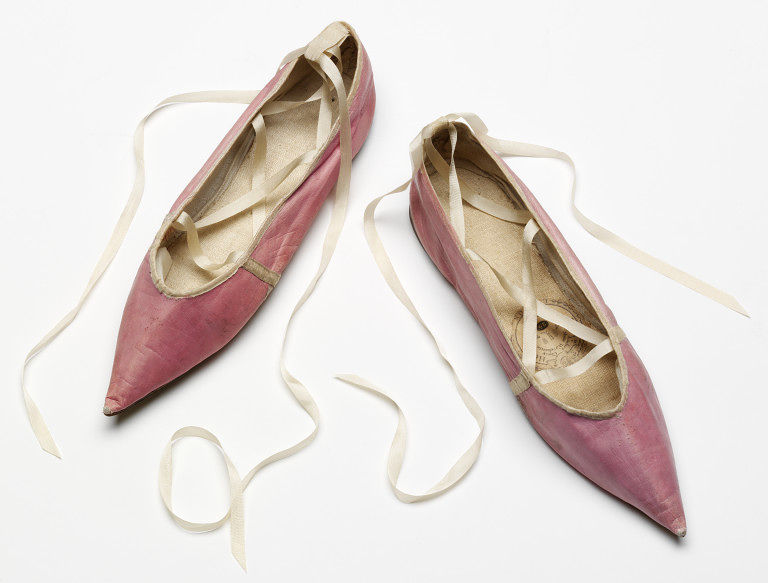
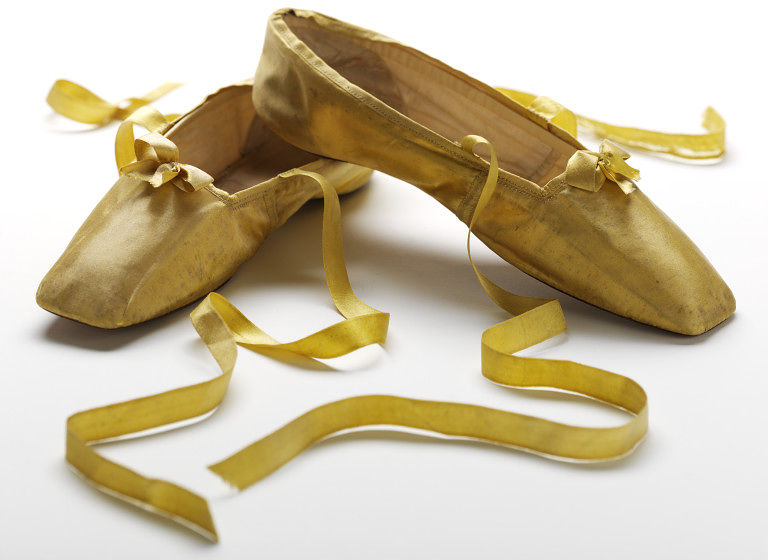
As we get into the 1800s shoes get simpler, with more rounded and later square toes and lower heels or entirely flat.  Still not something you'd go for a muddy walk in. They look more like ballet pointe shoes than a modern outdoor shoe, especially with the ribbons. Until the 1850s, this type of shoe (black or white mainly) was worn at formal occasions.  

White leather shoes worn by a bride in 1810

Yellow satin shoes with ribbons, 1820s

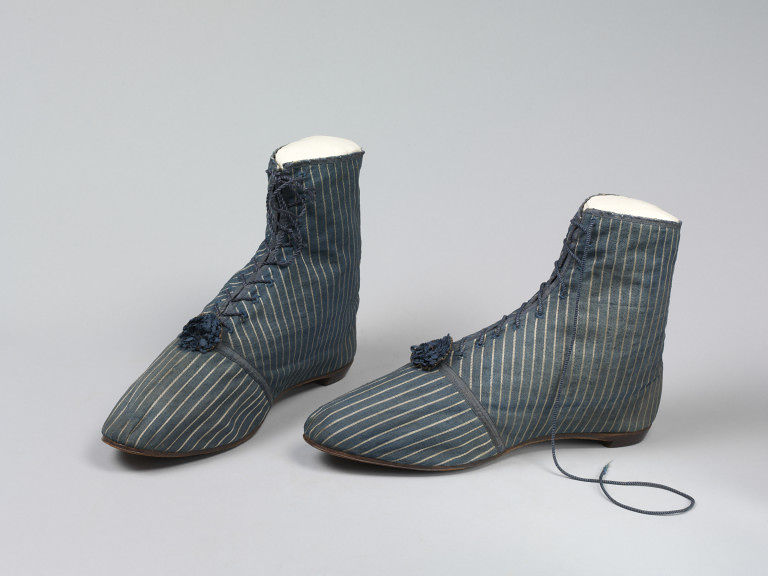
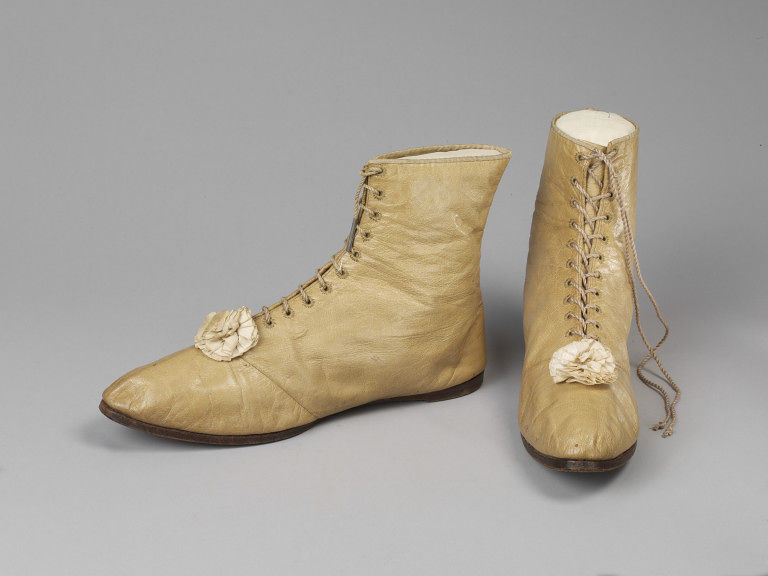
The good news is that at this point, boots become properly acceptable for women. They would have had leather soles and a kid leather or cotton upper. The cotton was a specific type from the Nanking region of China with a natural buff colour, and known as nankeen.

Ladies' half-boots in blue cotton

Kid (goat, not child) leather ladies' half-boots, 1815-1825

So what should I wear to best channel Lizzy on a three-mile walk to my local Netherfield? American Duchess tried to produce both leather and nankeen half-boots, but they are no longer in the collection and I suspect the shipping would have been prohibitive. I think the materials are more important to the experience than the exact style. Helpfully I seem to have found a modern 'nankeen half-boot' in high-top jazz dance shoes, with a leather sole, cotton lining and either cotton or leather upper. I will probably waterproof them with wax and possibly glue an extra leather sole on. For bonus points, they're affordable enough to potentially ruin on a muddy walk.

I totally recommend having a poke around the museum collections online, it certainly entertained me for a couple of evenings. I was absolutely astonished at how clumsy shoes look until the late 1800s.

Finally, two little asides I found in this rabbit hole: 

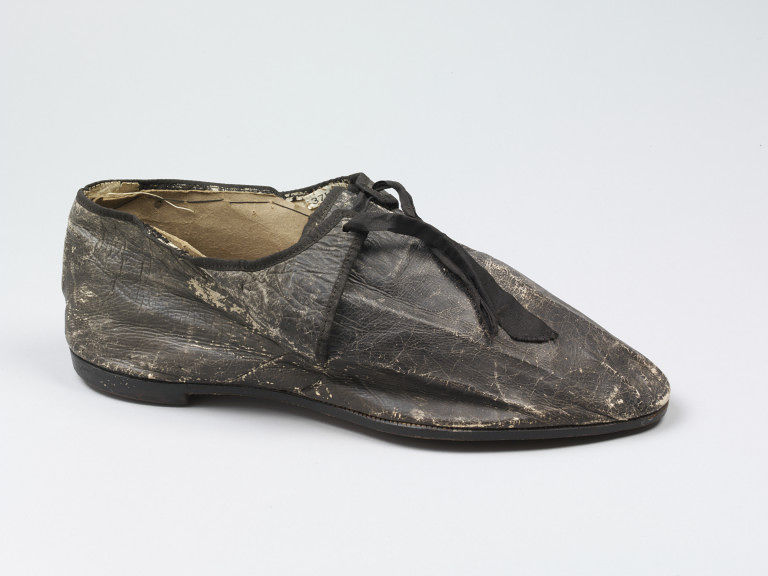
These mens' shoes look perfect for Mr Collins to tend to his garden in, and are some of the few examples available for men: 

A man's shoe, black with ribbon tie closure


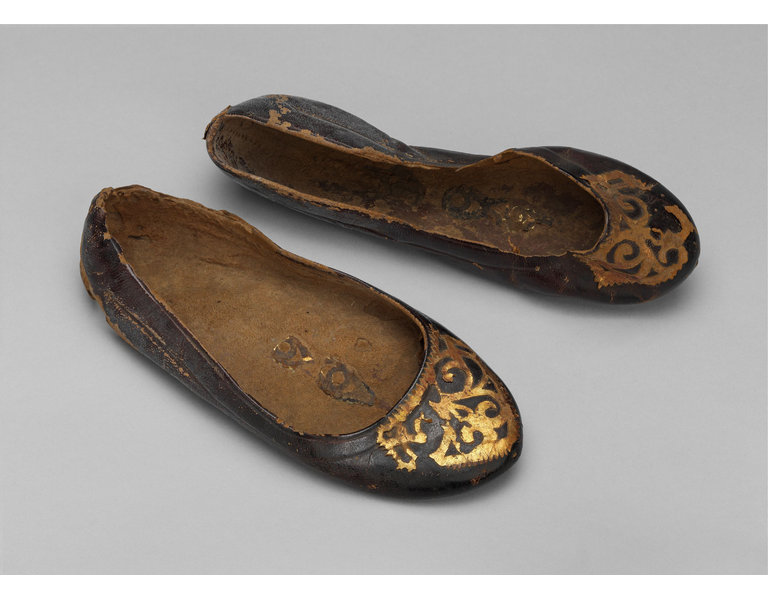
And a pair of 2000 year old shoes that honestly would look less out of place in a modern shoe shop than most of the other shoes in this post, and clumsy-looking later examples. I have a mighty need and may buy some leather flats to embellish with gold leaf (or paint). Because clearly I don't have enough projects.

pair of surprisingly modern-looking shoes, 30BC-300AD, Egypt.